eVTOL · Autonomy · Power
Raven
A tilt-rotor eVTOL and the first airframe of a 4-drone autonomous swarm
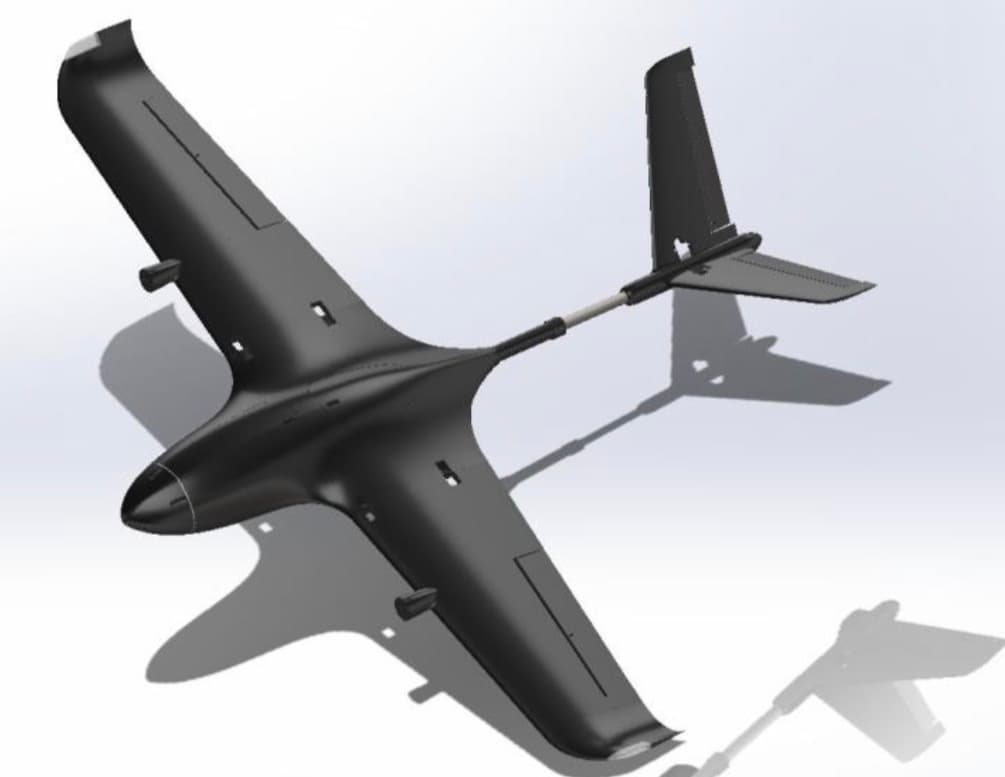
Fixed-wing in cruise, three-motor VTOL in hover. Designed, analyzed, and printed in carbon-fiber composite, on an 8-stage roadmap that ends in a fully autonomous 4-drone swarm with wireless charging at home base.
- 01Airframe structural build complete in PA612-CF15 carbon-fiber composite
- 02Every part reverse-engineered and re-validated from the stock platform: new material, new constraints, new geometry
- 03FEA on the main spar, motor mounts, and tail boom; CFD at 60 to 70 km/h cruise
- 04Tensile and torsion coupon testing to characterize the printed composite
- 05Designated senior design project and flagship hardware of a stealth AI startup
- 06FAA Part 107 certification in progress
- CAD & analysis
- Airframe build
- Electronics integration
- First flight
- Autonomy
Raven is a tilt-rotor eVTOL: two wing-mounted motors drive fixed-wing cruise, and a third motor near the tail joins them for vertical takeoff, hover, and landing. The airfoil is an Eppler E205, CFD-optimized for cruise at 60 to 70 km/h. It is built on the geometry of the Flightory Stallion FPV platform, but every part has been reverse-engineered and re-specified: stock LW-PLA/PETG replaced with PA612-CF15 carbon-fiber composite, custom carbon-fiber spar and boom tubes, self-selected programmable servos and avionics, and CAD modified wherever stock parts would not survive Raven's flight envelope.
- Configuration
- Tilt-rotor; 2 motors in cruise, 3 in VTOL
- Airfoil
- Eppler E205, CFD-optimized for 60-70 km/h cruise
- Primary structure
- PA612-CF15 carbon-fiber composite, custom carbon-fiber tubes
- Modularity
- 5-segment fuselage, detachable wing panels, interchangeable nose for payload swaps, V-tail
- Analysis
- SolidWorks Simulation + Ansys FEA; Ansys CFD; coupon tensile/torsion testing
- Status
- Stage 1 of 8: airframe complete, integrating electronics and flight code
Engineering scope
- CAD: re-specified every part to the new material and load constraints; modified geometry where stock parts fail Raven's envelope.
- FEA: static loading on the carbon-fiber main spar (bending), motor mounts (thrust and vibration), and tail boom mount (aerodynamic loads).
- CFD: airfoil performance and full-airframe flow at cruise.
- Materials: tensile and torsion testing on printed PA612-CF15 coupons; FDM/FFF print tuning with mandatory dry storage.
- Kinematics: servo-to-pushrod control linkages and snap-fit wing locks with torsion springs.
- Avionics: flight controller, ESCs, motors, receiver, and GPS selection; FAA Part 107-compliant wiring.
The 8-stage roadmap
- 01In progress
Mechanical build + RC flight
Airframe complete; integrating off-the-shelf flight controller, ESCs, motors, GPS. Manual RC control.
- 02Next
Autonomous flight
Programmable flight controller, GPS waypointing, basic mission planning.
- 03Future
4-drone swarm
Three more airframes; coordinated synchronized flight.
- 04Future
Object detection
Swarm flies pre-programmed patterns, detects trained objects, reports GPS coordinates to HQ.
- 05Future
HQ-side AI
Drones stream live video; HQ AI does analysis and mid-mission flight-plan updates.
- 06Future
Onboard control AI
AI moves onboard for adaptive control in harsh, uncertain conditions.
- 07Future
Onboard sensor fusion
Autonomous fixed-wing/VTOL transition, onboard detection, swarm and foreign-object collision avoidance.
- 08Future
Full IoT + wireless charging
Drones autonomously return to base, land in wireless charging stations, recharge. Zero human in the loop.
Startup context
Raven is the aircraft half of a two-product system at the stealth AI hardware startup I founded (pre-seed). The other half is an on-premise software brain that takes plain-language missions and coordinates a shared fleet, arbitrating multiple concurrent missions at once. The MVP is a live two-mission demo (a leak and an intrusion handled by one fleet), proven first in simulation and on commodity drones. An example end state: a fire department swarm that patrols a region on schedule, detects and classifies a hazardous fire, and dispatches verified information to first responders with no joystick involved. For more information, or if you are a VC or an investor, please contact me directly.
Airframe structural build complete
All PA612-CF15 segments printed and assembled: 5-part fuselage, detachable wings, V-tail. Moving to electronics integration and flight-code bring-up.
FEA and CFD pass
Static FEA on the main spar, motor mounts, and tail boom mount; CFD validation of the E205 section and full airframe at cruise.
Materials characterization
Tensile and torsion testing on printed PA612-CF15 coupons; dialed FDM settings and dry-storage workflow for the moisture-sensitive filament.
Project start
Selected the Stallion geometry as the base platform and began the full reverse-engineering and re-specification pass in CAD.